become deformed to the point where it
is no longer stable, which results in the
need to stop mining and repair the
roadway or, in extreme situations, may
even need a new roadway to be driven.
Extensive physical modelling, carried
out by DMT over the last two decades,
has allowed the company to establish
the nature and extent of such
deformation in the surrounding rock
mass and to create physical models to
demonstrate this deformation.
It is clearly important that the most
appropriate design of strata support is
adopted for the specific conditions
encountered, so that not only will the
roadway and workforce be protected
from roof falls, but also the deformation
will be reduced in order to maintain the
minimum cross-section necessary for the
operational needs.
In Germany, conventional yielding
arch supports have been used to depths
of up to 750 m. However, over time, it
has become clear that a support strategy
focused only on the minimisation of
support structure deformation does not
meet the support demands required at
greater depths. As a first step in
generating greater support rigidity,
backfilling with cementitious material
behind arch support was tested in the
deep German mines. Although this was
shown to be successful, the technique
was not considered to be viable due to
the time taken in setting up the support
structures, which is not compatible with
the increasing demand for speed of
advance.
The state-of-the-art technology used
today in the most highly stressed
roadways in German coal mines
involves the combination of rockbolting,
yielding arch support and arch
backfilling. Without this style of heavy
duty support, development of roadways
in coal mines depths of up to 1500 m
would not be possible.
With this method, rockbolts are
installed immediately after advancing
the roadway, as well as the use of other
methods of mass reinforcement. The
bolt density should be sufficient to
maintain stability of the roadway until
further support elements can be
installed. In the absence of this
immediate active support, it is unlikely
that deformation of the roadway can be
prevented.
Modern tools helping to
move support technology
forwards
Early methods of geotechnical
investigations, such as empirical
equations, were based on measurements
made in the mines and then correlated
with the geological conditions and
physical properties of the rock. Physical
models were used to further define the
basic parameters of the support system.
However, over the last 20 yr,
computerised numerical modelling
technologies have become increasingly
important and now lead the way in
analysing and optimising the support
solutions in current use. The application
of numerical methods becomes
extremely important when analytical
and empirical processes cannot provide
the required degree of accuracy because
of the existence of complex boundary
conditions.
For many years, DMT has used a
variety of numerical programmes for the
solution of different geomechanical
questions.
DMT employs numerical models for
a whole range of support design
assignments, such as:
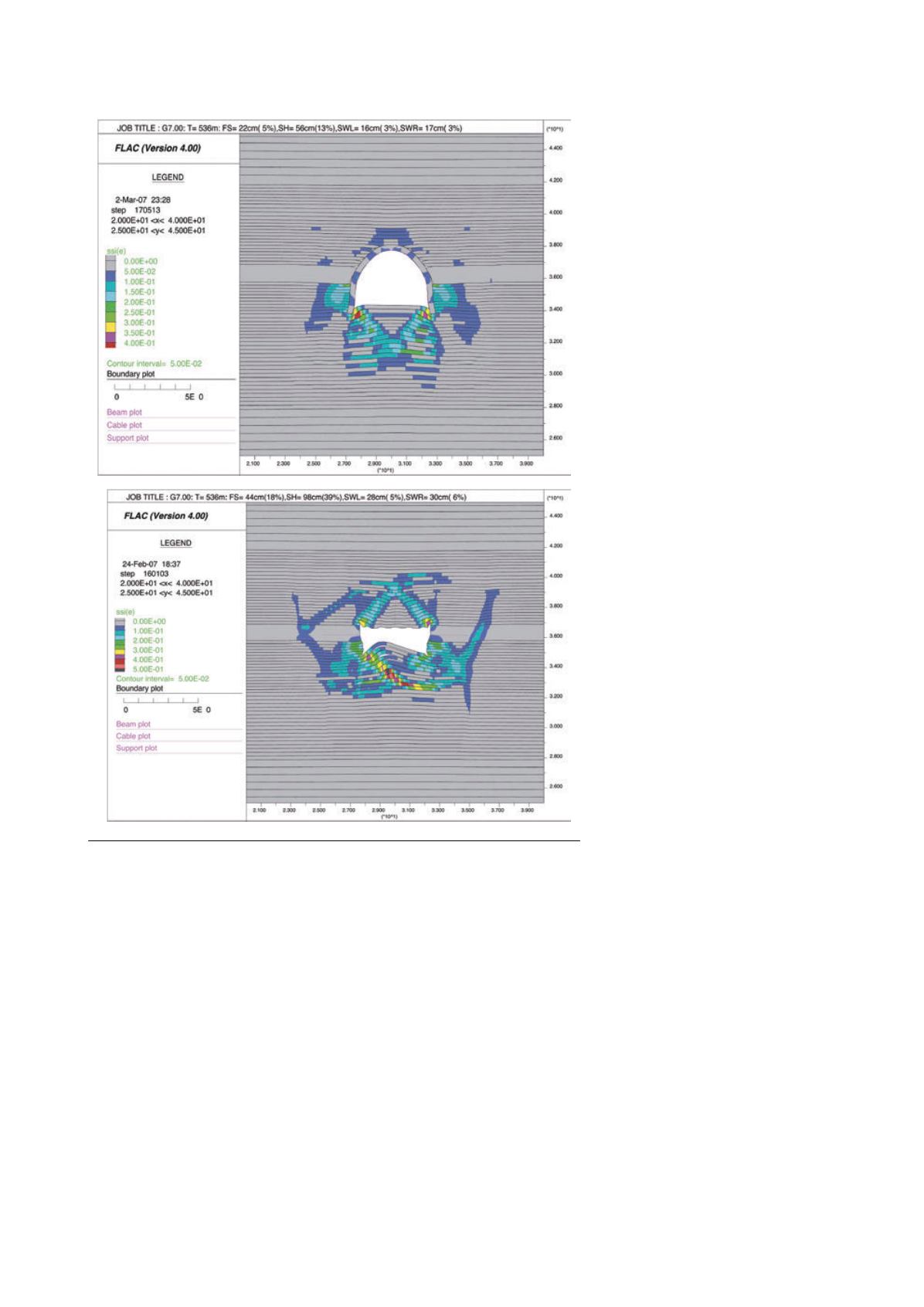
Figure 2. Numeric model in FLAC (Itasca). The top picture: arch shape with yielding
support with backfilling. The picture below: rectangular roadway with rock bolt support.
80
|
World Coal
|
August 2015


