n
n
Design of support structures,
requiring long-term stability of
underground openings, such
as shafts, pit bottoms or main
roadways.
n
n
Investigation of the deformation
behaviour of temporarily used
underground openings, such as
cavities, stopes or gate roads.
n
n
Design of necessary support
structures for gateways, as well as
production faces.
n
n
Investigation of the surface impact
of mining (surface subsidence,
damage etc.).
Numerical modelling process
essentially works by reproducing all of
the fundamental support elements
(rockbolts, standing supports, roadside
packs and injection material, etc.) along
with a wide range of boundary
conditions that apply in coal or ore
mining (geology, depth, single seam and
multiple seammining etc.).
Asoftware package, known as
GEDRU, was developed in-house by
DMT for large-scale stress redistribution
calculations. Currently, DMT uses FLAC
– 2D and 3D software (supplied by Itasca)
for local conditions modelling. In certain
circumstances, DMT also uses other
modelling packages, such as PFC (Itasca),
UDEC (Itasca) or Ansys (Ansys Inc.).
Transferring expertise
The applicability of the solutions
developed in Germany is a reasonable
question to ask and one that has been
asked by many DMT customers around
the world. Indeed, even in Germany the
empirical equations valid in three
deposits may not apply in the fourth
one. DMT’s experience, has shown that
modern methods of numerical
modelling, complimented by calibration
databases collected over the last five
decades, significantly reduces the time
needed to create tailor-made solutions
for various conditions found worldwide.
In any situation, it is always desirable,
and necessary, to undertake a limited
number of field measurements in order
to calibrate the numerical model to the
particular conditions. However once
calibrated, the models provide a high
degree of certainty when assessing
further variations in the stress
parameters or the configuration of
openings.
Many mines around the world are
now reaching depths of operation in
which the accurate assessment of
geological and geomechanical conditions
will be increasingly important. In these
cases, the adoption of traditional support
techniques that are designed simply to
contain and prevent roof falls will not be
adequate. However, in contrast to the
situation in Germany thirty years ago, the
strata control systems do not need to be
developed from scratch. Existing and
well-proven methods of analysis allows
the prediction of roadway deformation
and the selection of the most appropriate
support elements to be completed
quickly by analysis and expert clicks of a
computer mouse. This provides mining
companies with the possibility of saving
significant time and money, even in
changing geomechanical conditions.
It is vital to remember that it is easiest
to prevent or reduce deformation of
roadways at the mine design stage. With
this in mind, the type of modelling
described above should ideally become
an integral part of production and
planning process. If the potential
deformation can be predicted upfront,
reasonable investment in the most
appropriate support structures will
drastically reduce costly roadway
refurbishment works or, in the worst
cases, the need to drive new roadways.
Strata control: lean
management system
It is perhaps pertinent to ask: what does
it take to create an effective strata control
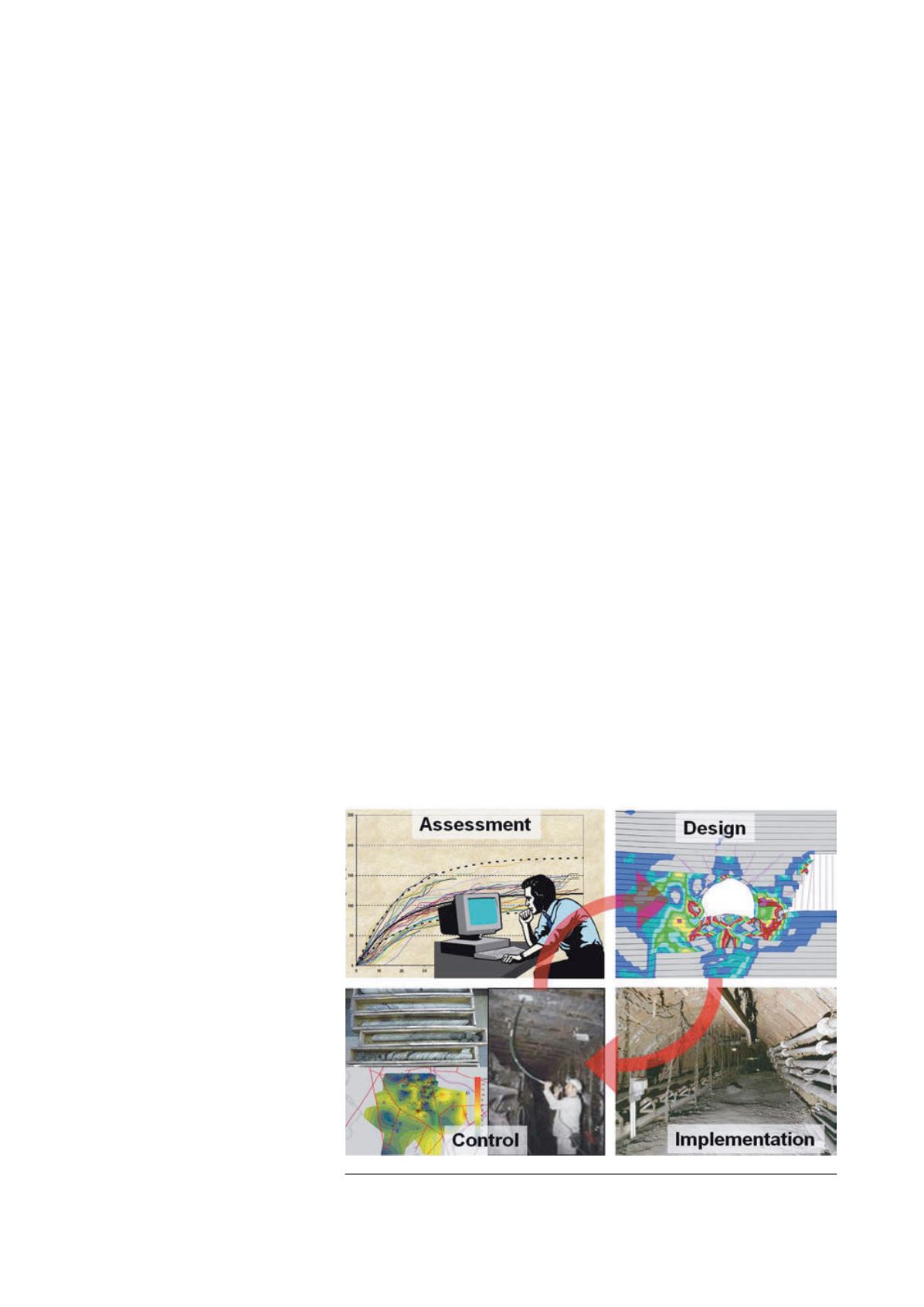
system? In the view of DMT, the most
appropriate approach is that shown in
Figure 3.
The best approach is to ensure that the
process is undertaken as a complete circle
that involves investigation and design in
accordance with latest practices,
implementation of the selected solutions
in the mine, conducting continuous
follow-up measurements underground
and then adjusting or calibrating the
solutions as result of the observations and
performance in the field.
If the deformation of the roadway
cannot be avoided, it is still worth
knowing how far it will deform and
whether there are measures available to
avoid or reduce it. This can be done by
applying comparatively low-cost
empirical methods that calculate the
deformation alongside the entire
roadway. Such methodology is often
very representative of reality, as it is
based on practical measurements
conducted underground and merged
into a big database of data. Rock
strength and density, displacements and
joints are also taken into account.
Such calculation will allow the basic
parameters of the support solutions to
be defined. To further refine this picture,
a clear understanding of the particular
Figure 3. System of strata control.
August 2015
|
World Coal
|
81


