These databases have been used
for design at many mine sites in
Australasia, Europe and the US. The
benefit for the mine using the
empirical databases is an effective
and practical support design, which
is based on both engineering
judgement and industry experience.
Conceptual models
Roof and rib behaviour in rectangular
excavations in coal mines begins with
the redistribution of the
in situ
stress
field, which, before excavation, is in
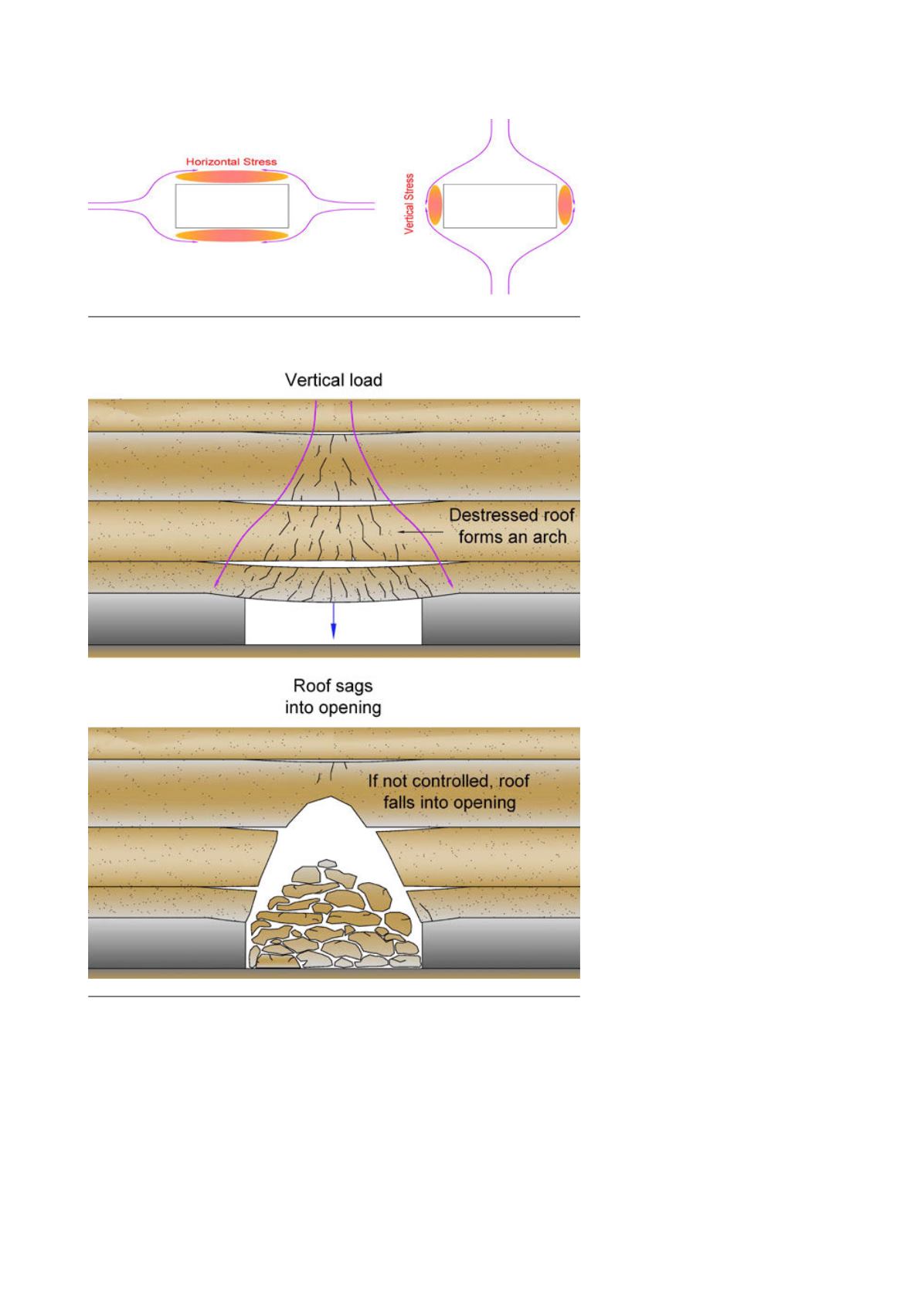
equilibrium. As stresses cannot travel
through voids (or roadways in this
case), they divert around the
openings and concentrate in the roof,
floor and ribs (Figure 1). Ignoring
geotechnical anomalies, the resulting
impact on the roof and rib conditions
is, in turn, a function of the
competency of the surrounding strata
and the excavation dimensions. The
modes of roof and rib behaviour are
therefore a function of the following
conceptual models.
Roof
The
in situ
stress in coal mines is
defined by vertical and horizontal
stresses. The vertical stress is related
to the weight of the overlying rock,
while the horizontal stress is
primarily related to plate tectonics.
Two horizontal stresses are evident: a
major and a minor, which are
typically oriented at 90˚ to each
other. Depending on the
in situ
stress
environment, the roof in sedimentary
layered rock can fail in two manners.
These modes are bending/block type
failures in low stress environments
and buckling beams in high
horizontal stress environments.
Bending/block failure
Bending or block type failure
typically occurs in low stress
environments. The likelihood of roof
failure in this environment is
dependent on the thickness of the
immediate roof units and the
composition of the immediate roof.
1
In either case, the lack of any
significant horizontal confinement in
the immediate roof strata can result
in bending or block failure due to
both gravitational loading and the
block’s own weight.
The failure starts immediately
after roadway development as the
immediate roof gradually sags into
the opening. As the beams in the
lower roof sag and separate from the
overlying units, the vertical load is
laterally transferred to the ribs.
1
This,
in turn, creates a distressed area
above the opening, which is typically
referred to as arching.
2
The roof sag
is aided by the low frictional forces
along the bedding planes of most
sedimentary rock types. If not
controlled, the lower beam can
collapse, leaving cantilevers as
Figure 1. Schematic showing the redistribution of the
in situ
stress field during
roadway development.
Figure 2. Schematic showing bending type roof failure.
84
|
World Coal
|
August 2015


