were needed in order to ensure that high
safety standards are constantly
maintained.
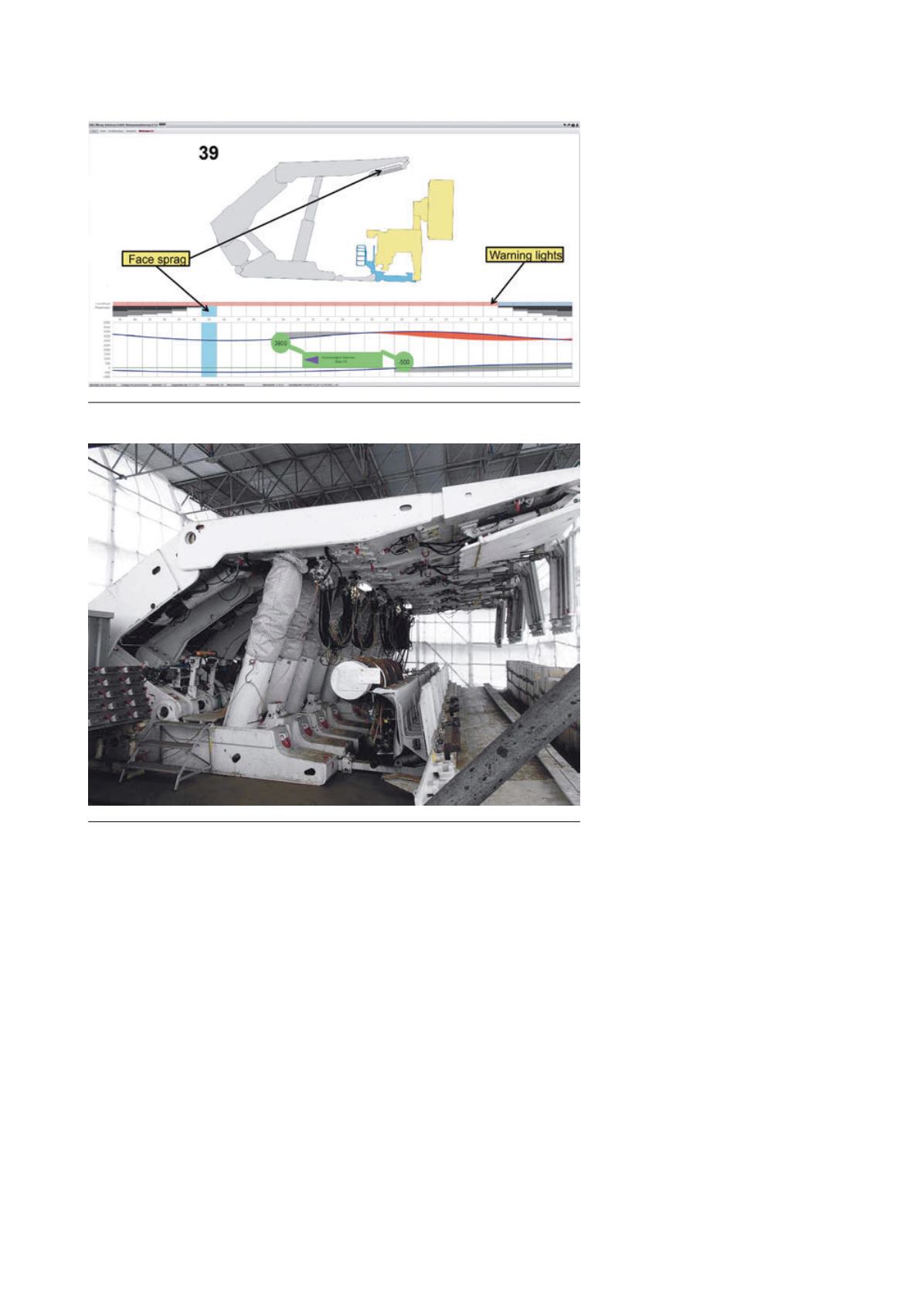
Figure 4 shows the testing and
training layout that was set up above
ground to carry out all of the different
performance tests and to provide a
learning and training facility for
machine operators, control station
personnel and face deputies.
The training face was used to test all
of the automatic functions before they
were installed and put into operation
below ground.
This short-face installation consisted
of seven powered-support units of
similar design in addition to those
already installed in the Zollverein panels
at Prosper-Haniel coal mine. A total of 20
additional support control devices were
also included on both the right and left
side of the test installation to simulate an
82 m long coal face.
Operating in conjunction with the
IPCs for the coal shearer and the
shield-support central control system
(face control centre), the surface
facility provided a set of realistic
conditions for testing the shield
automatic controls.
All of the development activity
associated with this particular
application called for a large amount of
fundamental research and feasibility
study work, the results of which are now
incorporated into a specific process
model that can also be transferred to
other production faces.
The experience thus acquired has
paved the way for a programme of
tailor-made operator and management
training sessions that are designed to
ensure that the product’s potential is
used to the full.
Operating experience from
the German coal industry
When operating coal faces at deep
levels, a large degree of mining
experience is needed in order to manage
geological factors, such as rock pressure
and methane emissions, as safely as
possible.
The following examples are taken
from Zollverein 1/2 seam at
RAG’s Prosper-Haniel coal mine in
Bottrop. This gassy seam is located at a
depth of 1200 m and has an average
thickness of 3.65 m.
As well as the high convergence rates
that were predicted in the gate roads
and the large quantities of dirt produced
from the face, the main challenges facing
the mine management were the high
in-seammethane content and its impact
on face operations. Figure 6 shows the
relationship between desorbable gas
content and panel layout.
In order to minimise any future
disruption to the winning process, a
large number of preliminary gas
drainage holes had to be drilled during
the roadway drivage phase. The stress
that this caused to the seam negatively
affected the stability of the coal face and
posed an additional risk for the face
team. Given the conditions as described,
coal production had to be maintained
under the threat of gas outbursts and
this meant being able to steer the shearer
without any visual contact with the
machine.
The intelligent face automation
systemwas developed for working
Zollverein 1/2 seam and, given the
danger presented by potential gas
outbursts, was designed to enable the
on-face operator to remain at a safe
distance from the machine when cutting
coal. Due to the lack of visibility at such
a distance, it is not safe for the operator
to steer the machine by remote control.
Therefore, it is vital that the shearer
can be operated without visual contact
Figure 3. Visualisation of the face situation.
Figure 4. Testing and training set-up.
70
|
World Coal
|
August 2015


