abutments for the next beam so each
layer above the roof has, in effect, a
progressively smaller span.
Continued failure of the beams
eventually produces a stable,
trapezoidal opening.
3
This process is
illustrated in Figure 2.
Bending failures are typically
related to beams, which are
considered continuous structures that
carry overlying weight. In most coal
mine roofs, however, the strata is
jointed and made up of individual
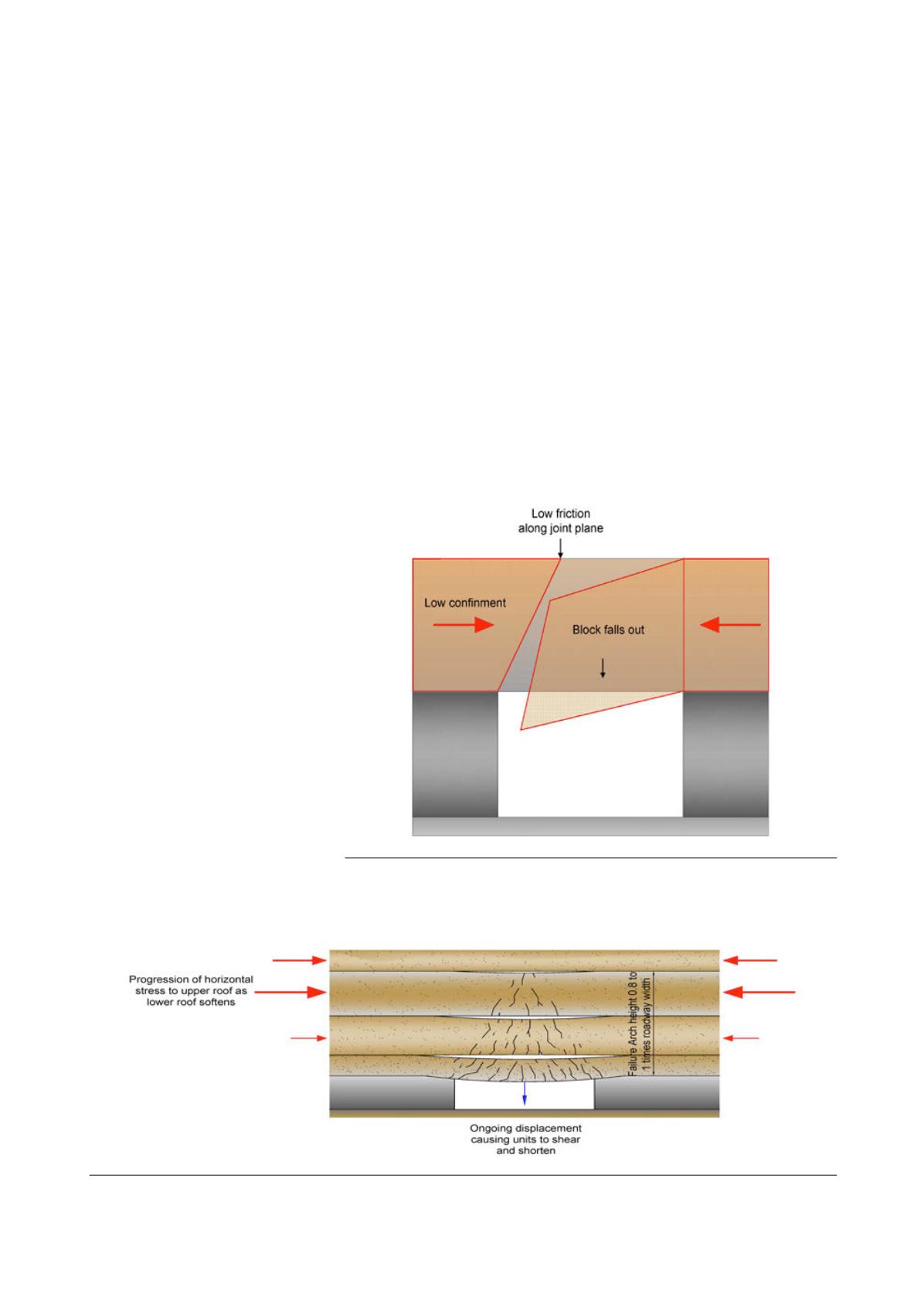
blocks. When these blocks are
subjected to low confinement, they are
susceptible to sliding along joint
planes, which are typically
characterised by low frictional
properties. This process is illustrated
in Figure 3.
Buckling failure
In classical beam theory, buckling can
be defined as a mode of failure
generally resulting from structural
instability due to compressive action
on the beam. As most roofs in coal
mines comprise sedimentary‑layered
rock, the individual layers of the strata
can be susceptible to buckling along
bedding planes under the action of
horizontal stress. When considering
Euler’s buckling beam theory, the
likelihood of buckling occurring
during roadway development in coal
mines is a function of unit thickness,
horizontal stress magnitude,
competency of the strata and the
elastic modulus of the rock.
During buckling of the roof strata,
the increased amounts of
displacement will cause the units in
the lower roof to shear and thus
shorten. As a result of the stiff nature
of the loading system, the horizontal
stress and associated confinement
reduces during this shortening
process. The horizontal stress will
then transfer to the overlying stiffer,
intact beams, which are still confined
by the
in situ
horizontal stress. If not
controlled, this process can repeat
itself up to a maximum height that is
determined by the roadways failure
arch (Figure 4). The maximum height
typically assumed for failure arches
in coal measure strata is 0.8 – 1 times
the roadway width. The resulting
breakdown or ‘softening’ of the roof
and associated loss of confinement
increases the likelihood that the roof
will fall if not controlled.
Ribs
Most researchers agree that the
failure mechanism for coal ribs is
related to buckling columns.
4,5,6
When considering Euler’s buckling
column theory, the main factors to
consider are depth of cover, the
height of the rib, the thickness of the
column and the strength of the coal.
Additional factors to consider are
cleat orientation, cleat density and
prominent banding in the coal. It is a
common occurrence in coal ribs that
buckling can initiate at the interface
between the stone bands and coal due
to slipping along low friction layers.
Figure 3. Schematic showing block type roof failure.
Figure 4. Schematic showing height of failure arches above roadways.
August 2015
|
World Coal
|
85


