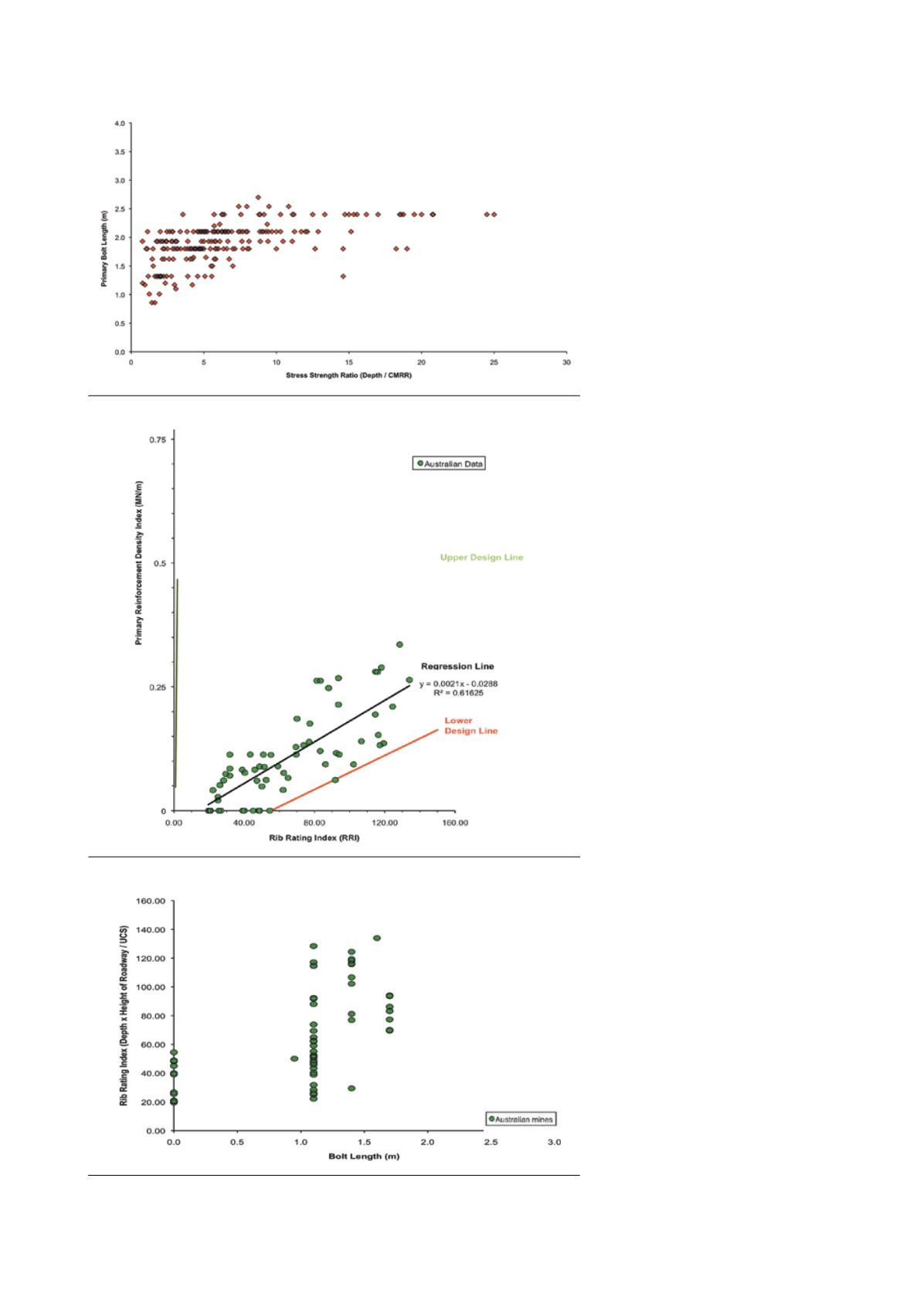
coal regions, roof bolt lengths of
between 1.8 and 2.4 m are typically
installed. This trend is almost
certainly related to the likelihood of
increased levels of roof displacement
progressing higher into the roof at
these SSRs. Although the database
indicates that these bolts lengths are
sometimes installed below SSRs of
10, the general trend shown in Figure
8 indicates that shorter bolts are
installed at lower SSRs.
Primary rib support
database
Accepting that the main failure
mechanism for coal ribs is buckling
columns, the main parameters in the
database are depth of cover, roadway
height and average
in situ
coal
strength. The depths in the database
range of 100 – 595 m and the
roadway heights range between
2.4 and 5.5 m in the Australian data.
In order to arrive at a
representable average coal strength
for each coal seam in the database,
use was made of geophysical data.
The average coal strength was
determined using a Sonic derived
UCS from site-specific geophysical
data. McNally
indicates that for coal,
the relationship between sonic transit
time (t) and UCS can be expressed
using the following equation:
8
UCS = 250000
e-0.076t.
Using this equation, it was
determined that the average
in situ
UCS of the coal seams in the
database ranges between
4.6 and 45.4 MPa.
In order to determine the likely
magnitude of rib deformation during
roadway development, the above
factors are combined to form the Rib
Rating Index (RRI) using the
following equation:
RRI = (H x R
h
) / S
n
n
H = depth of cover (m).
n
n
R
h
= roadway height (m).
n
n
S = average coal strength (MPa).
As shown along the horizontal
axis in Figure 9, the RRIs for the
Figure 9. Golder's Primary Rib Support database for Australian mines.
Figure 10. Golder's Primary Rib Support database showing bolt length in Australian mines.
Figure 8. Golder's Primary Roof Support Database showing bolt length.
88
|
World Coal
|
August 2015


