Rig control system
The automation platform for
Atlas Copco blasthole drilling
equipment is the rig control system
(RCS), which is based on standard
PC-computer technology. The new
generation of RCS rigs has taken a
quantum leap forward with respect to
logging capabilities, serviceability and
drilling accuracy. CANbus technology
provides the backbone of this new rig
control system. It is flexible and easily
expandable, allowing new units to be
added anywhere along the data bus by
cable.
The electronic modules are all
developed solely for the RCS rigs and
are ruggedised and protected from
external magnetic and electric
influences. For surface blasthole
machines, the flexibility of the system is
highly utilised and can be adapted and
configured for a variety of product
types. Customers can start at a low-level
of automation and, as their requirements
change, can upgrade. New functionality
can be added without major rebuilding
of the machines.
Safety features
The RCS Basic provides the machine
with additional standard interlocks,
compared to the electric‑over‑hydraulic
machines. A few of the interlocks created
with the software are:
n
n
Hole depth indicator: displays the
rotary head position, as well as the
depth of the hole drilled.
n
n
Pipe in hole tram interlock: rotary
head must be in a safe position to
allow tramming.
n
n
Jack interlock: pipe in the hole will
disable jack functions to protect the
machine and reduce bending of
rods.
n
n
Rod support interlock: prevents
damage of the rotary head and rod
support by not allowing feed with
rod support to be in the stowed
position.
n
n
Carousel no-bump: prevents
damage to the carousel by limiting
pulldown pressure when the
carousel is not in the stowed
position.
n
n
Breakout wrench protection:
prevents damage to the breakout
wrench by disabling pulldown
when the wrench is not in the
stowed position.
n
n
Engine and electric motor
information displayed over the
touch screen maintenance screens.
n
n
Low fuel, lube and water level
messages.
n
n
Tram interlocks, so a trigger must be
activated to allow tram function.
GPS hole navigation
To ensure the blasthole is precisely
positioned to where the mine engineer
has designed the blast pattern and is
drilled to the correct depth, GPS hole
navigation has been developed for the
RCS platform. This hole navigation
system uses antennae mounted on the
tower rest and radio antennaa on the
cab to produce an accurate bit position.
Drill plans designed with the local mine
coordinates are imported into the
system and the bit position is provided
in real time. The bit position is precise
and is calculated by taking into
consideration the variability on the
bench, providing the operator with the
correct depth to drill each specific hole.
This feature also provides a moving
map display with zoom functions as
the rig is trammed closer to the desired
blasthole location. The dominant
system for positioning of a rotary drill
on a blasthole drill plan is with satellite
navigation based on GPS or GPS and
Glonass.
It is possible to reach accuracies of up
to ±10 cm, depending on installation and
the number of available satellites. The
integration of the GPS receiver to the
control system is done via a standard RS
serial link. The preferred protocol to use
is the standardised NMEA0183. The
advantage of having the GPS system as
a positioning sensor enables customers
to choose products of any brand
(Trimble, Leica, Topcon), depending on
the preferred standard in the actual
mine.
Rig remote access and
communication
The rig remote access (RRA) system
fromAtlas Copco gives a customer the
ability to connect the drill rigs to a
standard computer network on a
worksite. The RRA system allows
access to information on the drill rigs
from any authorised point in a network.
The RRA system basically consists of a
communication server onboard the drill
rig and a network adapter. The server
supplies the user with three functions: a
web server that can connect to any
standard web browser, an FTP server to
enable transferring of data (files) to and
from the drill rig and a server process
that enables any data to be integrated
into the user’s administrative systems.
If a commercially available ‘office’
network is used on the worksite, which
is easy to install into the existing
infrastructure, it restricts the RRA
functionality to only remote access and
does not permit remote control.
Standard communication equipment is
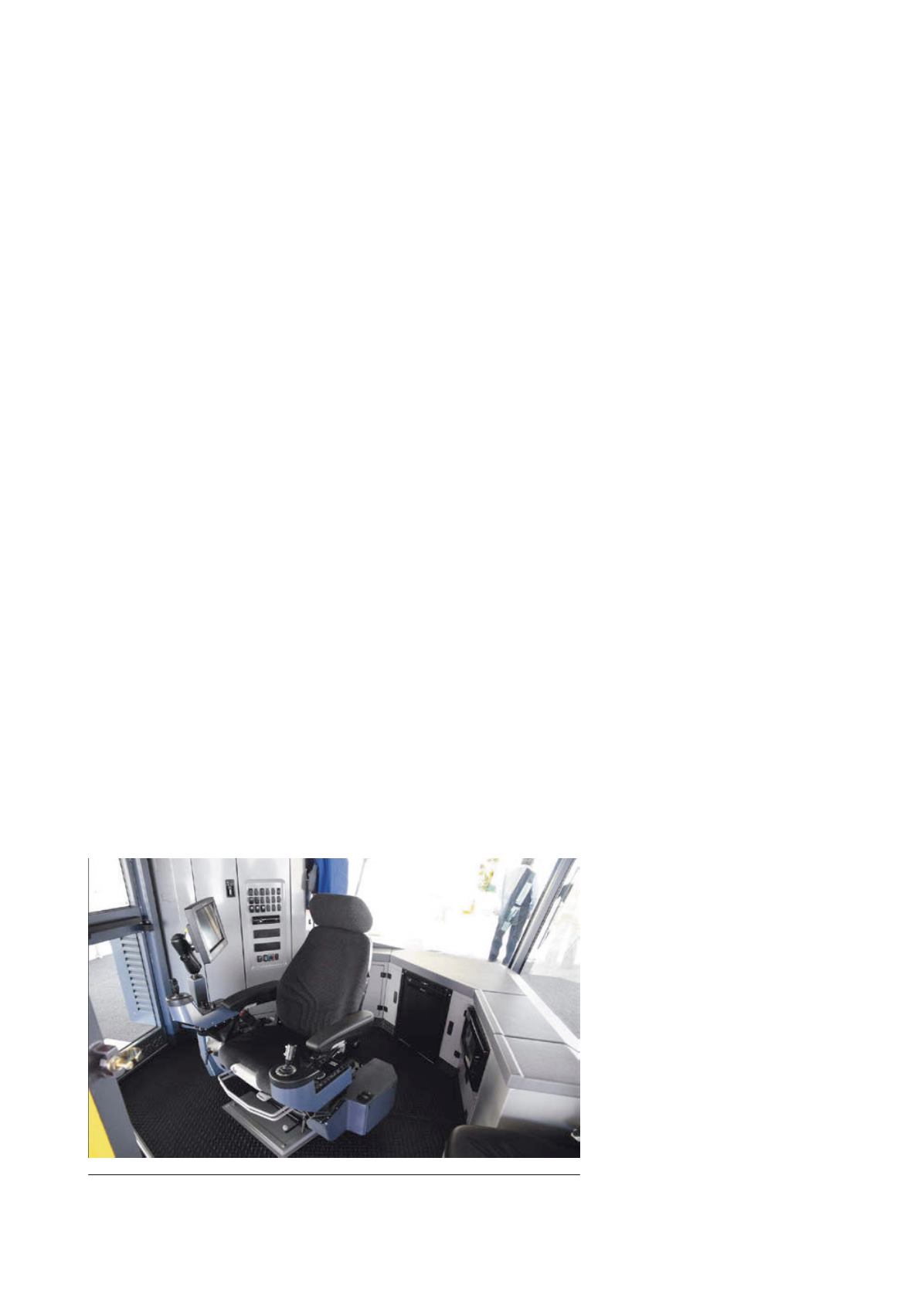
RCS cabin on a PV-310 series.
96
|
World Coal
|
August 2015


