the form of a stockpile using an
automatic stacker. Then, as needed,
blended coal is reclaimed using an
automatic reclaimer and conveyed to
two surge bins. These surge bins
discharge coal into two hammer‑mill
crushers: crusher 1 and crusher 2.
Each crusher has a normal throughput
rate of 750 tph. The crushed coal then
discharges into the crusher discharge
chutes beneath each crusher. Each
crusher discharge chute has a diverter
arrangement that can discharge
crushed coal on either belt conveyor
RC2 or belt conveyor RC3. The
inclined conveyors RC2 and RC3
transfer coal to inclined belt
conveyors RC4 and RC5 using two
chute arrangements with diverter
gates. The conveyors RC4 and RC5
transfer coal to the tripper floor of the
boiler silos.
The transfer chutes and
flow issues
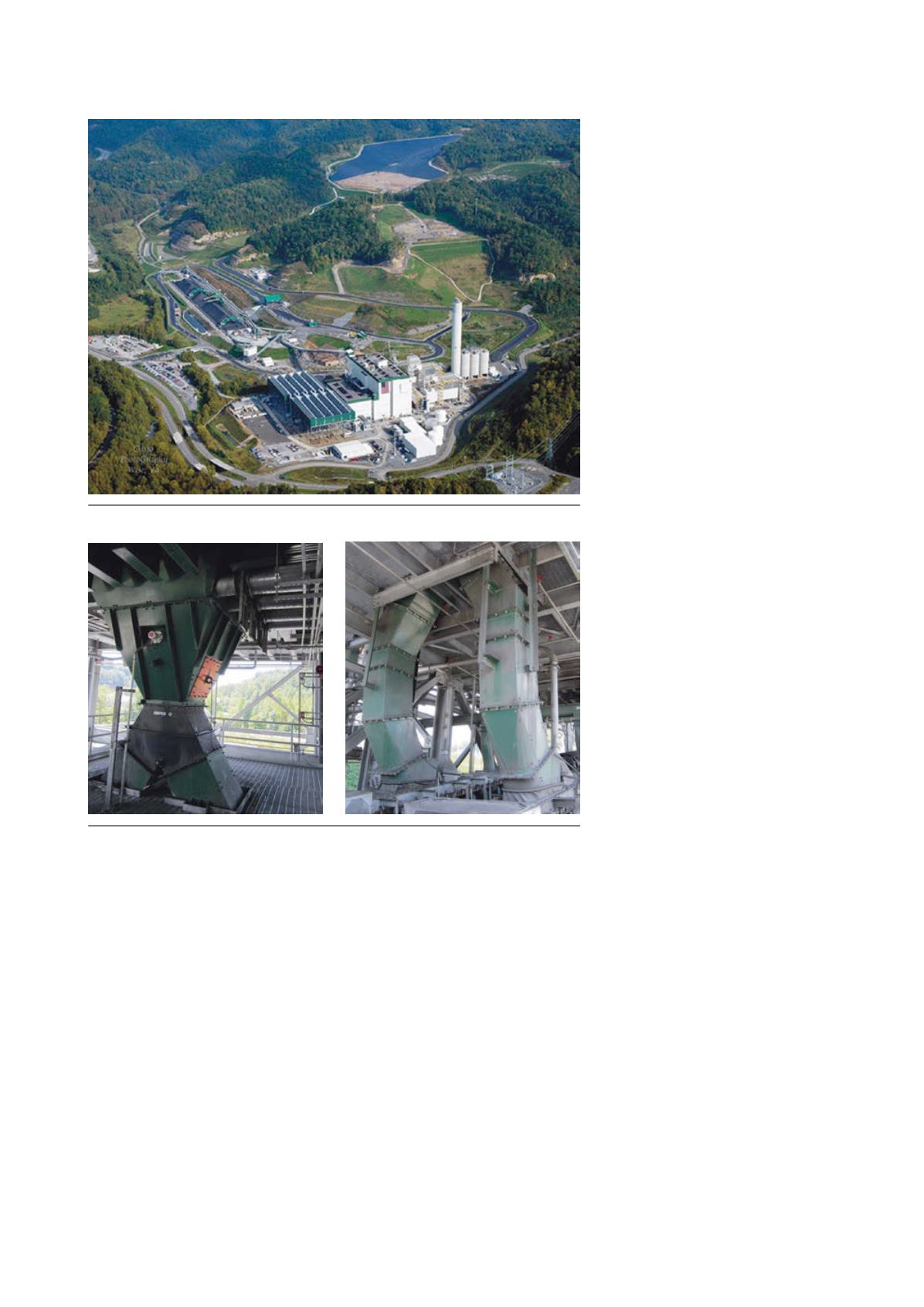
Figure 2 shows the original discharge
chute configuration for crusher 1. The
discharge chute for crusher 2 had
similar arrangement.
The original chute arrangement
had a pyramidal collection hopper at
the top with 10 ft 7 in. long by
9 ft 5 ½ in. wide inlet with 24˚ and
21˚ hopper walls (angles measured
from the vertical). This arrangement
resulted in about 31˚ valley angles.
The bottom square opening size was
only 2 ft. 5 ¼
in. The collection
hopper was lined with 304 stainless
steel plate. Below it, a diverter
arrangement directed coal onto
either RC2 or RC3 belt. Both belts
were 42 in. wide, with 35˚ equal
length troughed idlers. The belt
conveyors ran at 578 ft/min.
Plant personnel reported that the
crusher discharge chutes experienced
material buildup (Figure 3), especially
when handling fine and moist waste
coal. If unattended, the material
buildup led to plugging of the chutes.
When plugging occurred, manual
intervention was required to restart
flow.
Figure 4 shows the original chute
arrangement for belt conveyor RC3;
chute arrangement for belt RC2 was
similar. Belts RC4 and RC5 are 48 in.
wide with 35˚ idlers, and run at
578 ft/min. Conveying direction of
belts RC4 and RC5 makes a 113.3˚
angle (measured clockwise) with the
conveying direction of belts RC2 and
RC3. These chutes are nearly 50 ft tall.
The chute arrangement had several
sections, including a diverter gate to
direct discharge coal on either belt
conveyor RC4 or RC5.
Plant personnel reported that these
chutes experienced material buildup
(Figure 5), especially when handling
fine and moist waste coal. These
issues mainly occurred in the upper
part of the chute arrangement that
had multiple zig‑zag shaped sections
and a narrow diverter arrangement. If
unattended, the material buildup led
to plugging of the chutes. When
plugging occurred, manual
intervention was required to restart
flow. Operators needed to use
hammers, poke rods and water lances
to clear buildup.
These transfer chute arrangements
were not suitable for handling fine
waste coal with high moisture
content. Thus, when such coal passed
through these handling systems, flow
problems occurred. Virginia City
Hybrid Energy Center decided to
modify the transfer chute
arrangements to improve
Figure 1. Virginia City Hybrid Energy Center.
Figure 2. Original discharge chute for crusher 1 – top section (left) and bottom section
(right).
44
|
World Coal
|
August 2015


