circumstances, its savings on dump
rehabilitation may result in significant
savings for Anglo’s South African coal
business and the coal mining industry.
This would be achieved either by
eliminating the need for topsoil
entirely or by significantly reducing
the quantities required to achieve the
desired rehabilitation outcome.
Lessons
Whether Fungcoal can be replicated at
different sites depends on a number of
variables. In the first place, a suitable
source of weathered coal needs to be
available within a reasonable distance
to the site. Should the distance be too
great, it is likely that conventional
rehabilitation with sub- and topsoil
would be more cost effective.
Additionally, the medium on which
the Fungcoal is intended to be applied,
whether it is coal discard or opencast
spoils, needs to be suitable. Where the
medium is acid generating, or more
precisely where the acid neutralising
capacity of the medium is insufficient,
Fungcoal will probably not succeed.
Importantly, Fungcoal needs to fit
in with the expectations of interested
and affected parties, particularly
regulators and local communities.
Where the purpose of rehabilitation is
to create a stable land form for grazing
or wilderness land use, Fungcoal is
probably suited in most instances.
Where the land has to be returned to
high‑quality arable capability,
Fungcoal on its own may not be
adequate, although it may support
improvement of the quality of
rehabilitation in terms of organic
content and decompaction of the soil.
Sharing innovation
While the technology has been
patented, Anglo American has taken a
decision not to use it to pursue
commercial value, but to improve the
quality of rehabilitation across the
mining industry for the benefit of the
natural environment and communities
that host mining sites. The company
has shared the technology and
research in various scientific and trade
publications.
In doing so, Anglo American seeks
to progress the development of
Fungcoal by gaining wider acceptance
across the sector and increasing its use,
as well as engaging with regulators
and continuing to monitor the trial
sites over time.
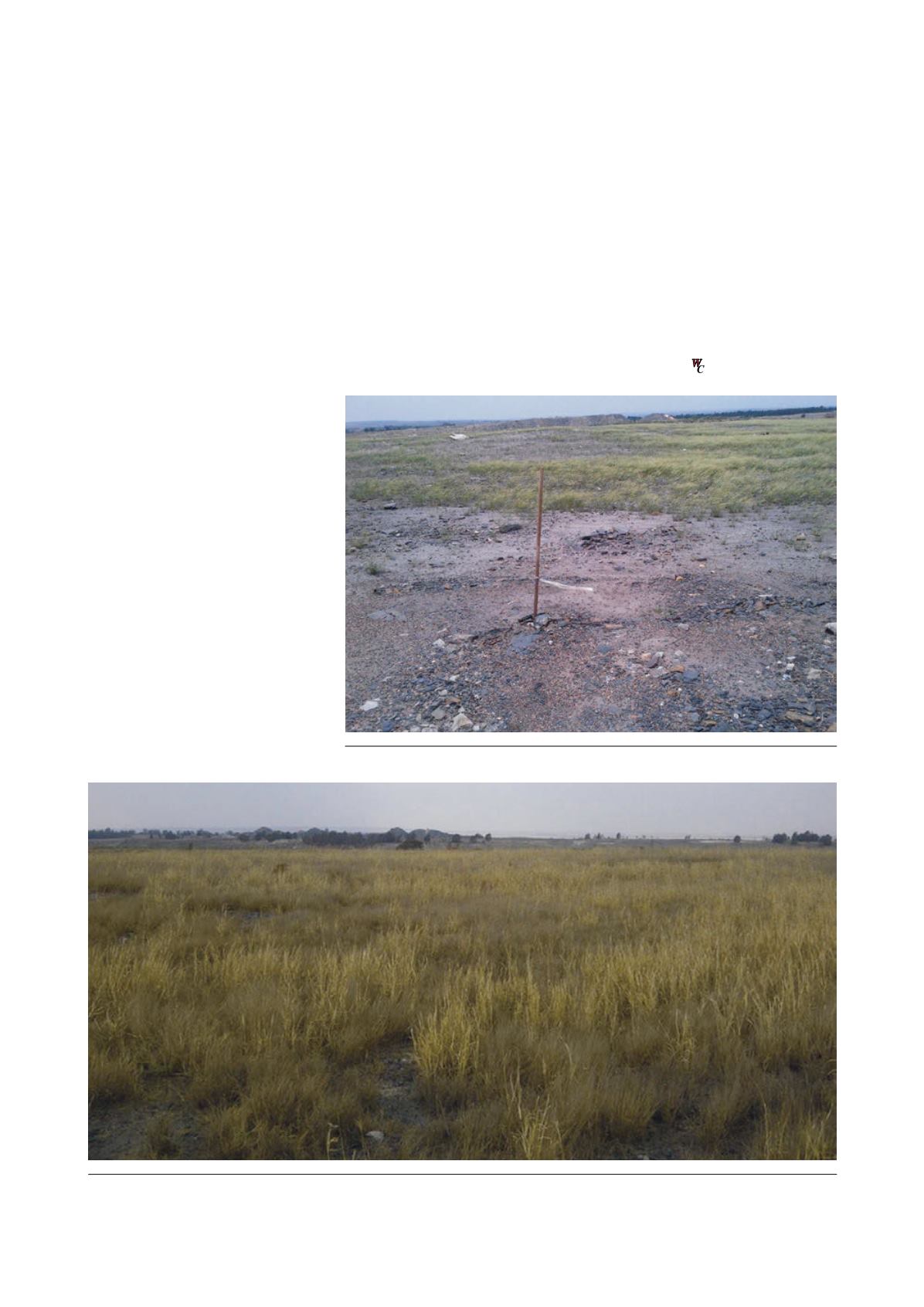
Figure 1. Kromdraai untreated.
Figure 2. Kromdraai treated.
August 2015
|
World Coal
|
101


