conveyances in an appropriate and
calculated manner for a case of an
overwind situation, in compliance with
Polish regulations.”
A two-rope friction winder of 4.2 m
dia. is installed to achieve mine coal
production of 3 million tpy. The installed
motor power is 2000 kW, operating the
skips with 12.5 t payload at a speed of
12 m/sec. over a hoisting height of
479 mwith the Siemag Tecberg Winder
Drive Control STB-SC02. The respective
visualisation was successfully
implemented and commissioned, since
demonstrating its high reliability.
The coal industry in Poland has an
exemplary rescue organisation,
Centralna Stacja Ratownictwa
Górniczego S.A. in Bytom (CSRG),
employing competent rescue teams and
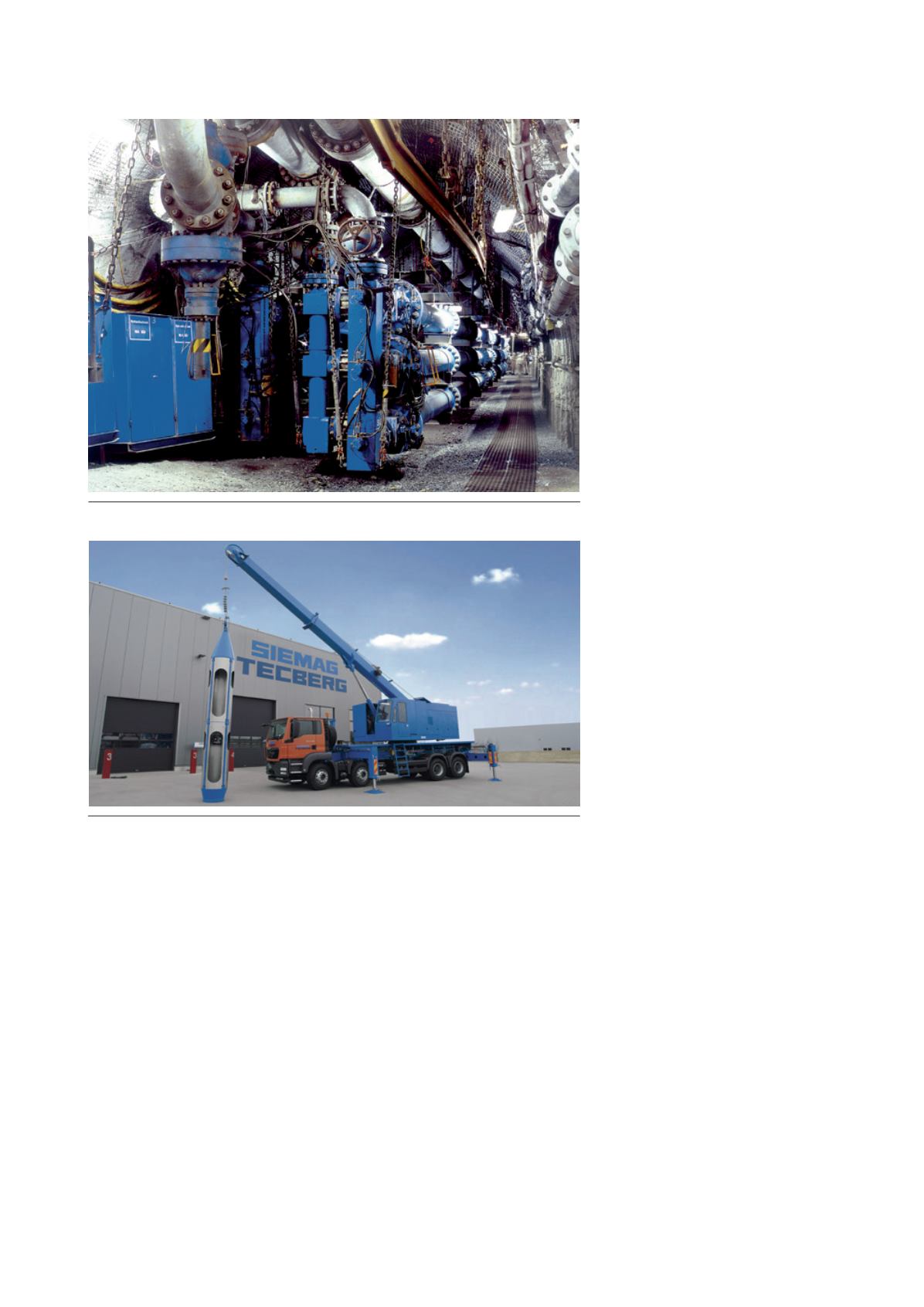
using two mobile hoisting systems that
can serve about 100 shafts in the
Katowice area. Since 2004, they have
used a Mobile Shaft Winch, which
basically is a complete autonomous
system for rescuing people and
inspecting shafts. It allows a service load
of 5 t with the largest boom
displacement, which makes it very
flexible to meet the different local
conditions and limitations. CSRG is now
acquiring another winch to replace an
older smaller winch it owns. It is
intended that the new systemwill have
a range extended even further and be
more flexible in use.
Siemag Tecberg has built several such
Mobile Shaft Winches to the mining
industry with a bench marking
performance. The latest winch was
supplied to XinwenMining Group Co.,
Ltd in China for serving shafts with a
depth of max. 1200 m.
According to Ken Nelson, President
of Siemag Tecberg US: “Most US coal
mines are less than 300 m deep. The
service hoist requirements can be very
impressive for loads – slope hoists
handling 100 t longwall equipment or
cage-counterweight service hoists with
40 t loads – all at low speeds. The
dynamic nature of coal mines (frequent
movement of access shafts) has provided
many opportunities for Siemag Tecberg
to assist customers with relocating
service hoists and upgrading them to
handle the ever-increasing loads of
newer longwall equipment.
There are also some impressive
production hoists at deeper mines such as
a 3.66m/12 ft Koepe with
5150 kW/7000 hp drive on a 500 m+ shaft
and several single drum (over/underlay)
production hoists, which are very
productive and simple to operate."
Coal mines are often at shallow
depths in South Africa andAustralia.
“Our experience is with single drum
winders operating on inclines, some of
them slow speed heavy lift machines for
moving the heavy equipment in and out
of the mine,” said Helgard Honiball,
Executive Director of Winder Controls
South Africa. “More recently, we have
been involved in large cage slow speed
friction winders for Sasol Coal in
Mpumalanga with typical vertical shafts
90 – 130 m depth. The configuration is
Koepe double wrap with main and idler
drums and rope doubled down. Thus
the conveyances are operated with
2 falls x 4 ropes of relative small
diameter. Sasol Coal represents potential
repeat business as the large coal seam
(up to 4m in height and 40 – 50 m in
width) extends for many kilometres,
which means that new shaft systems are
regularly required to extend the
operations.”
Michael Fitjer, Technical Director
Siemag Tecberg Australia, continued:
“Man and material hoists are quite
common for both vertical and inclined
shafts and there are some existing bulk
coal winders. Most coal opportunities
are in New South Wales and here MDG
Siemag Tecberg Mobile Shaft Winch – Xinwen project.
Siemag Tecberg Pressure Exchange System in coal mine.
58
|
World Coal
|
July 2015


