contract language. Both ASTM and
ISO have a number of different
sampling methods and, without
specifying, either party can select an
inferior method and still be in
compliance.
ASTM and ISO have standards
addressing both mechanical and
manual sampling of coal. Mechanical
sampling is addressed by ISO 13909
and ASTM D 7430. Manual sampling
is addressed by ISO 18283 and
several different standards in ASTM.
One is manual sampling using
part-stream sampling (D 6609); the
other is stationary sampling in
railcars, barges or stockpiles
(D 6883). Thus, any of the manual
methods in these standards could be
used and still be “in accordance with
ASTM (or ISO) standards”.
Ranking the sampling
methods
Below are the details and ranking of
these various sample collection
methods, which will allow the user
to better select the method they
actually require for their transaction.
In ASTM Standard D 2234, the
standard practice for the collection of
a gross sample of coal, the sampling
methods are ranked from best to
worst in accordance with their
condition. ISO standards are in close
agreement with this. They are as
follows:
n
Condition A: stopped‑belt cut
sampling.
n
Condition B: full‑stream cut
sampling.
n
Condition C: part‑stream cut
sampling.
n
Condition D: stationary
sampling.
The key to understanding why
condition A is the best method and
condition D is the worst method is
that many of the coal characteristics
that are commercially relevant
(moisture, ash, calorific value, etc.)
are not distributed equally in the
different size fractions in the
consignment.
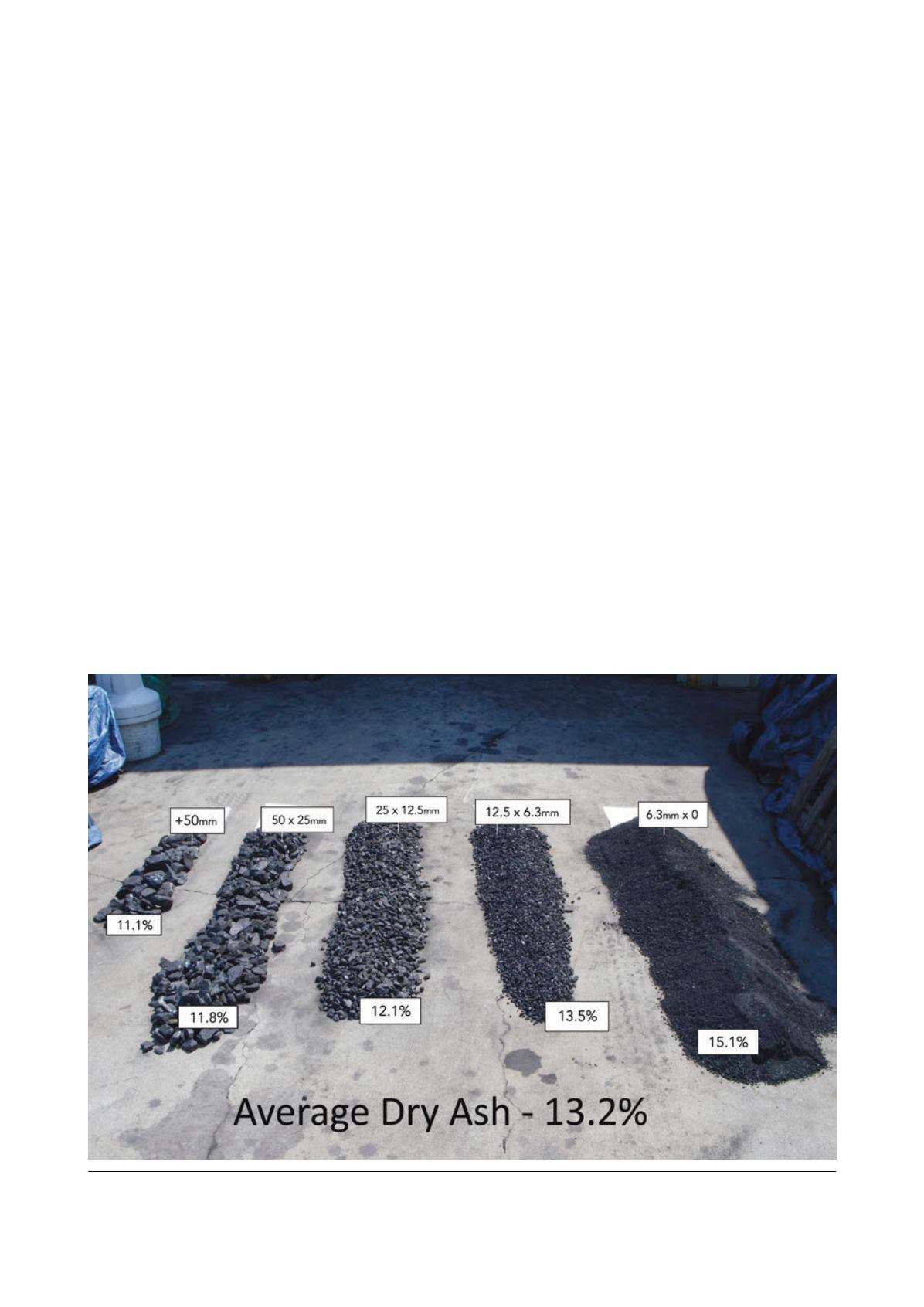
A simple, but important, example
of this is shown in Figure 1. This
shows a sample from a barge of coal
from a single mine, which is first
screened into its various size
fragments and then analysed for dry
ash. The resulting distribution of ash
in the different size fractions is very
typical, with lower ash in the larger
pieces and higher ash in the smaller
pieces. Many coals have wider
ranges compared to the example
here. Ash content and calorific
content are inversely proportional; as
the ash rises the calories fall.
Moisture content is directly
related to surface area, therefore the
same effect is seen in percent
moisture with the fine coal having
much higher moisture content than
the larger pieces. These two
distributions of high ash and high
moisture in the fines have a
compounding effect on one of the
most important commercial issues:
as‑received calorific value.
Due to this disproportional
distribution of important
characteristics in the different size
fractions (true for most bulk
materials), the true objective of any
Figure 1. The ash content changes with different sized particles.
28
|
World Coal
|
August 2015


